Showing posts with label bunny williams. Show all posts

Monday, January 30, 2012

Your Bed, Your Sanctuary


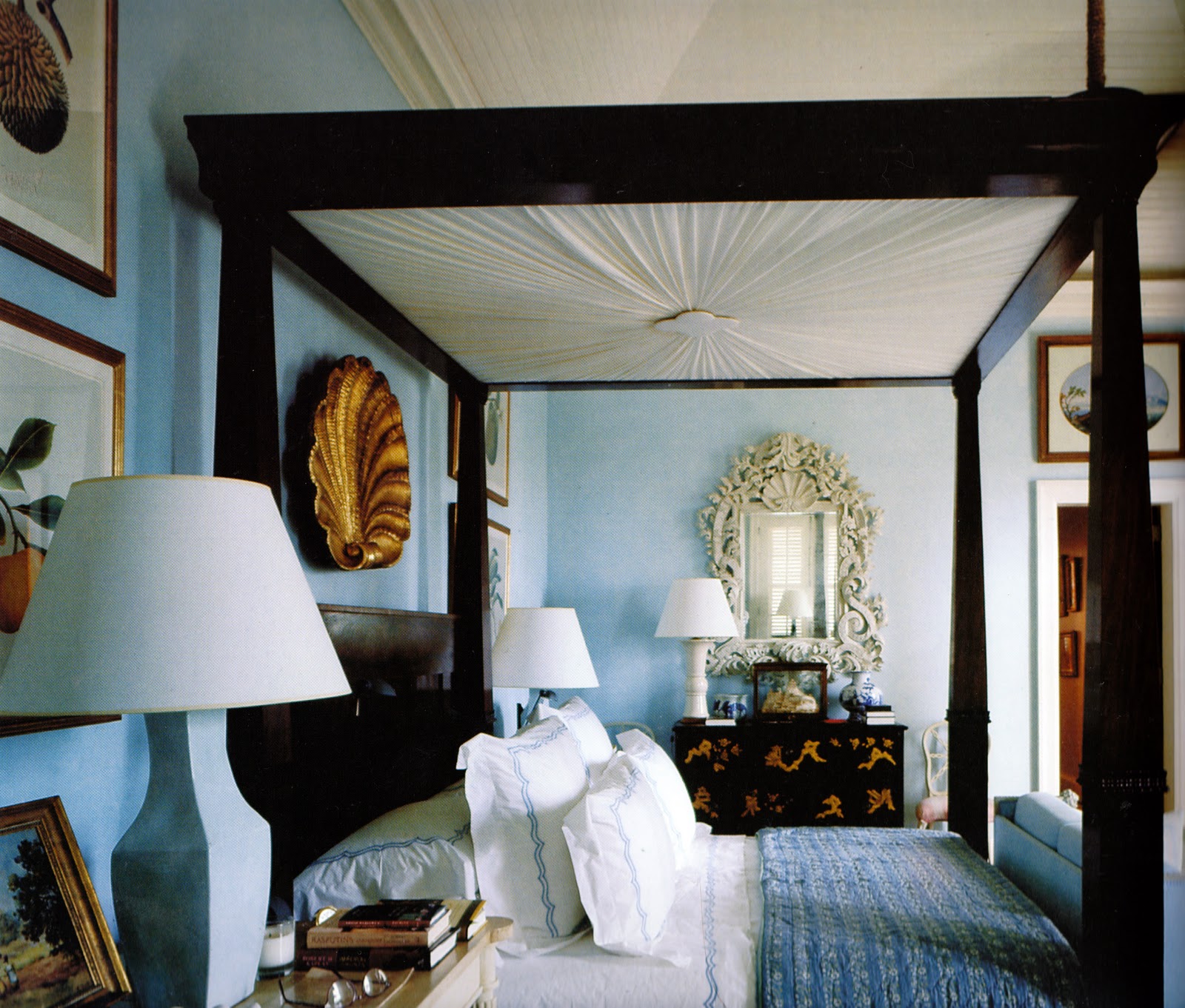
Lauren King's master bedroom, as featured in Architectual Digest.
Maybe it's because the world has become a foreboding place, but in recent months, I've decided that the only bed worth having is a BED--a piece of furniture that's cozy and enveloping, that's a home within a home, a place where you can retreat and feel safe, comfortable, and at peace.

Auctions are excellent places to buy beds. In fact, I'd go so far as to say it's the single least appreciated item of furniture you can purchase at auction. You get serious deals. This is because you are only rarely bidding against antiques dealers--they don't like to carry an item that requires so much room to display and can take a while to move. So that's one reason. The other is that the casual buyer gets nervous because older beds do not always conform to modern mattress sizes. But so what? Custom mattresses are available everywhere now. They cost about 25-30% more, but honestly, with a mahogany bed from Hickory Chair or Baker costing $10,000 and up, you are still going to be thousands of dollars ahead of where you'd be otherwise, with something more unique to boot that will better hold its value. 

This week, we will be looking at several styles of beds, beginning with my favorite style, the antique American or English wooden bed frame.

Bunny Williams's 19th c mahogany bed graces her bedroom in the Dominican Republic. From Bunny Williams' Point of View: Three Decades of Decorating Elegant and Comfortable Houses.
20th century oak canopy bed, at Christie's in New York on Feb 7th, estimate $1,000-$1,500.
Granted, you won't find many antique king beds, but you will find great deals on 20th century king frames, such as the ones above and below, which are coming up at Christie's next House Sale on February 7th-8th.
Recover the headboard, even paint the frame if you want, for a completely different look.Oak, four post bed, at Christie's on February 7th, estimate $1,500-2,000.


Antique Wooden Beds

Measurements for beds can be tough to interpret, since the auction houses give you the outside dimensions of the frame. This is particularly problematic for antique wooden beds. Will your mattress--spouse, five dogs--fit or not? To find out the answer, just email or call the auction house and request the interior dimensions where the mattress goes. (I'm telling you, if auction houses just provided this outright, they would have much more success selling beds, then again, they would probably sell for higher prices, so...)  The largest antique beds tend to be an inch or two off of a queen, which means that you can either get a custom mattress, or get a good restorer to try to extend the frame. A typical stripping and refinishing on a queen sized frame should run you between $500-$1,000. Update the rails or extend the frame, and you might be looking at a few hundred more.  But as you can see from the estimates below--and beds tend to really sell within or below the estimates, I've found--you'll still be saving huge amounts of money and saving an American treasure.


I love this room because it shows how, with a great bed, little additional adornment is necessary. From Country Living.


American Federal carved four post bed. At Neal on February 4th, estimate $2,000-3,000.


Beautiful 19th century canopy bed, at Cowan's Auctions, Inc, in Ohio on February 25th, estimate $800-1,000.


I normally don't like black and white designs, so I was surprised how well I thought this room came together. The strong mahogany furniture is balanced by the strong graphics and the result is very fresh, I think. From Country Living.
NEAL auction house in New Orleans is among my favorites for its consistently excellent selection. Up for bidding on February 4th,  a four poster American cherrywood bed, estimate $1,000-1,500.  
 

Curly maple cannonball bed, circa 1830. At Cowan's on February 25th, estimate $600-900.

Lovely country bedroom with bamboo canopy bed. From Elle Decor.

If you have to sleep on a twin bed, make it a twin four poster. They give the small frame stature and substance. One of my favorite Mary McDonald rooms, below, features twin four post mahogany beds and is another example of how the bold, some say heavy, American style of furniture goes well with strong graphics and colors.
From Mary McDonald: Interiors: The Allure of Style
(that's an orchid in the foreground, in case you were wondering).


A stunning pair of Louisiana convent beds. Estimate $500-750. (There is a note about the condition, but no note! Be sure to get a condition report, since the estimate is low).

A pair of white painted twin beds, at Christie's, New York, on February 7th, estimate $1,000-$1,500.
More beds later in the week. Happy bidding everyone!

Monday, January 2, 2012

Mantle Clocks: Ring in the New Year, Part One

Courtesy of Bunny Williams' Point of View

Ringing in a new year causes one to consider the passage of time, of course. Thus, it seems only fitting that my first posting in 2012 is about clocks--mantle clocks to be precise. Mantle clocks are trusty, medium-sized timepieces, ranging from 8-18" in height, that, in our modern era, also serve as very elegant and adaptable accoutrements. Frequently found at auction and surprisingly reasonable in price, mantle clocks make wonderful wedding, anniversary or housewarming gifts for a cherished (and lucky!) friend or family member. They are also a great layering piece for one's own home. This week, we will explore several styles frequently found at auction in two separate postings. Today, we have the fancier examples, with the humbler, primarily American, mantle clocks coming later in the week. Enjoy.

Gilt Mantle Clocks


Bunny Williams's ormolu mantle clock.
Let's begin with gilt clocks, since they reflect the origin of the mantle clock, which began in 18th century France during the reign of Louis XV. We'll start with one of my favorites: Bunny Williams's ormolu clock depicting a gardener (seen here and at the top of this blog). I just love the gilt hydrangea that comes out of the "wheelbarrow." In Point of View, the designer writes that she found this timepiece in California (which wouldn't be my first guess), and "could not live without [it]." I love it too, and have never seen anything like it in all my years scouring auction houses.

19th c French ormulu mantle clock. At Roland, New York on January 7th, estimate $400-500.


French Empire mantle clock, at Freeman's in Philadelphia on January 25th, estimate $1,500-2,000.
Now, mantle clocks need not be limited to the mantle. Interior Designer Suzanne Rheinstein uses a gilt clock to great effect on a desk in this gorgeous green bedroom.

A bronze dore clock, above, enhances this green guest room, courtesy of At Home: A Style for Today with Things from the Past.


19th c. Empire style clock. At Freeman's on January 25th, estimate $800-1,200.
19th c French empire gilt-bronze clock. At Leslie Hindman on January 25th, estimate $3,000-5,000.

  By 1850, advancements in manufacturing suddenly made it feasible to produce mantle clocks on a vast scale. The Ansonia Clock company, based in Ansonia, Connecticut, manufactured thousands of cast metal clocks between 1850 and 1929. Clocks done in the French style, such as this Vassar clock, were  popular with those in the middle class with champagne tastes, albeit a less accommodating budget.


Ansonia Figural mantle clock. At Bruhn's in Denver on January 15th, estimate $275-400.
   On the other end of the spectrum is this stunning, 19th century Parisian clock. Given its generous dimensions (26.5" highx 15.5" wide), this clock must have adorned quite some mantle in its day.

French gilt-bronze figural clock. At Christie's on January 10-11th, estimate $4,000-6,000.


Empire Style

An Empire clock graces a mantle in a Bunny Williams dining room. From Point of View.
During Napoleon's reign, French design became decidedly more restrained. No longer looking to Versailles for direction, French artists, caught up in the democratic fervor of the time, harkened back to Greece and Rome. This rebirth of classic influences--neoclassicism--long outlived the emperor; indeed, it became the prevailing design style of the 19th and 20th century, popular to this very day. So-called "Empire" mantle clocks appear in many shapes and sizes, but the signature, iconic style is the portico clock, which gets its name because the clock face appears suspended between (or in some cases perched above) ionic columns. Depending on the style, portico clocks can look fantastic in modern settings.
Charles X Empire Clock. At Freeman's in Philadelphia on January 25th, estimate $800-1,200.


French Empire Style clock. At auction in New Jersey on January 16th, estimate $300-400.
This stunning Italian clock sold, fittingly, on New Year's Day. The hammer price was $500.


Michael Smith is one of my favorite designers. I've always loved this guest bedroom, which appears in his book Elements of Style.The Empire clock looks so wonderful on this dresser (though, um, it is a dresser has been so styled it wouldn't hold any of YOUR things).

A gilt bronze Empire clock with all the bells and whistles. In Palm Beach on January 16th, estimate $2,000-3,000.

A mantle clock can be a nice focal point atop a chest of drawers. From Point of View.


French Empire Style inlaid rosewood mantle clock, at auction in Denver on January 15th, estimate $475-600.

A neoclassical style gilt-bronze clock. In Chicago on January 22nd, estimate $600-800.

Suzanne Kasler uses an Empire clock on a sideboard.

As mentioned, there will be more mantle clocks to come later in the week. For now, Happy New Year--and Happy Bidding!


Monday, December 19, 2011

Holiday Decor: the Ornament Tree

My original inspiration, from one of Martha Stewart Living's early books: Handmade Christmas
I am not a handy person, nor am I particularly good at arts and crafts. Having said that, during the holidays I do pull out my glue gun for one particular type of decoration and one only: the lovely ornament tree.

As the name suggests, the ornament tree is a tree-shaped decoration comprised externally of glass ornaments, typically glass balls. In order for these trees to look truly special and timeless, I have found through experience that at least a third of the ornaments used should be vintage due to the gorgeous luster and patina that old ornaments have developed after years of mouldering away in attics. Because one of the easiest and most reliable places to find vintage ornaments is on eBay; I thought these holiday decorations would make a fitting topic for a December blog.

I first learned about the ornament tree in Martha Stewart Living's 1995 book, Handmade Christmas. The magazine's version, pictured above,was accompanied by the instruction to find an 18" styrofoam cone and 250 vintage glass balls between 1/2 and 1" in diameter. Those, plus a glue gun and an antique urn would result in a beautiful and timeless Christmas decoration.

One of a pair of ornament trees I made for my sister. They look so pretty in candlelight!

Above, you have my first effort. I kept the colors in the aqua, silver and gold family because I gave a pair of these trees to my sister, who has hand painted wallpaper in her dining room in these muted tones. This year, she put the trees on her living room mantle and went sans urns, which as you can see looks nice as well.


Now, from my earlier comment, you probably have gathered that I do not use purely vintage balls. This is because they are more expensive than new ones, and when you're using 250 balls or so, that price difference is really noticeable. What I recommend instead is creating a stockpile of old and new ornaments and stuffing them away until inspiration strikes.

New Ball Ornaments
Obviously, it's much cheaper to buy glass balls after the holidays when stores have them on sale, so be on the lookout. That said, I have found that the cheapest, most reliable source for contemporary glass balls to be florist supply websites, which sell them in large boxes. Designed to be attached to wreaths, the balls are on a stem, which is perfect for this use because the stem can be poked into the styrofoam form ( you need to use glue as well, which we will get to in a minute). Be sure you have a set of pliers on hand to cut the extra wire, as you won't need the full length of it.


Glass ball ornaments, designed for wreaths., are perfect for ornament trees.
 I really like Kelco, which has so many colors and sizes and also sells their balls in varying quantities, for those of you with limited storage space (or a reluctant obsession). Jamali Garden is a bit pricier, but the site is very user friendly and has a variety of colors (the store, located in the plant district in NYC, is fun to visit too).


Vintage Ball Ornaments

As mentioned, vintage ball ornaments are readily available on eBay. Note that the prices can really vary, with the "Buy It Now" options typically being more money than they are worth. Shiny Brite was a very common mid-century brand and works very well for this project. (Searching for Shiny Brite glass ball ornaments also narrows your results to a more managable quantity.)

Here's an example of a typical eBay auction lot that would work nicely:

A nice sized lot of vintage glass ball ornaments on eBay.
 Note, you don't want many, if any, balls bigger than 1 1/2 inches (or the 35mm size). You will need a lot of very small, feather tree ornament sizes for the top of your tree and to fill in gaps, so stock up those.


Other Supplies


A more modern, red-themed ornament tree, topped with a vintage indented Shiny Brite ornament purchased on eBay.

In the interest of variety, you might wish to purchase vintage ornaments in other shapes. I find these trees look really nice with a tree topper, and love to use an indented ornament for that, such as the one pictured below. Other supplies you'll need include tree forms in either styrofoam (which I have used), bottle brush or tinsel (which I haven't but want to try). Of course, this ornament concept works well in wreath form too, and I see no reason why one couldn't do small balls or a topiary form. Blues and silvers would be gorgeous for Hanukkah. If you use the styrofoam, you are better off spray painting your forms with either a silver or gold so that the gaps in the balls don't reveal such a bright white. A floral supply shop will have both the forms and the paint.


You also need suitable containers, either old or new. Err on the side of too small a container rather than too large, for if the container is too small, you can always whittle down the styrofoam, and it will make for a tighter fit. I recommend that you design your tree in container you'd like to use, so you stop gluing at the appropriate level. .
Gardeners like Bunny Williams
may not need to go far to find suitable containers for ornament trees. Urns are particularly well suited.

Don't forget your glue gun. It is vital that you use a strong glue that bonds at high temperature. The high temperature glue is tricky because it can cause very thin glass to shatter, so it's a bit of a balancing act. I still prefer it because the lower temperature glues don't form a strong enough bond, and your ornaments will loosen and fall off your trees too easily...which leads me to the final thing you'll need. Save those styrofoam pellets, they make the perfect "nest" for your trees during the off season! You'll want to carefully place your tree or wreath in a garbage bag first, though, so you don't lose any loose balls in the pellet miasma, never to be found again.

Those are all the tips I have for now. Please write me and let me know your experience making these pretty holiday decorations--I will post any success stories to my blog! Merry Christmas! Happy bidding--and happy tree trimming too!